- عربي
- 中文
- English
- Français
- Русский
- Español


UNESCO Executive Board Discusses JIU Review of Management and Administration in UNESCO
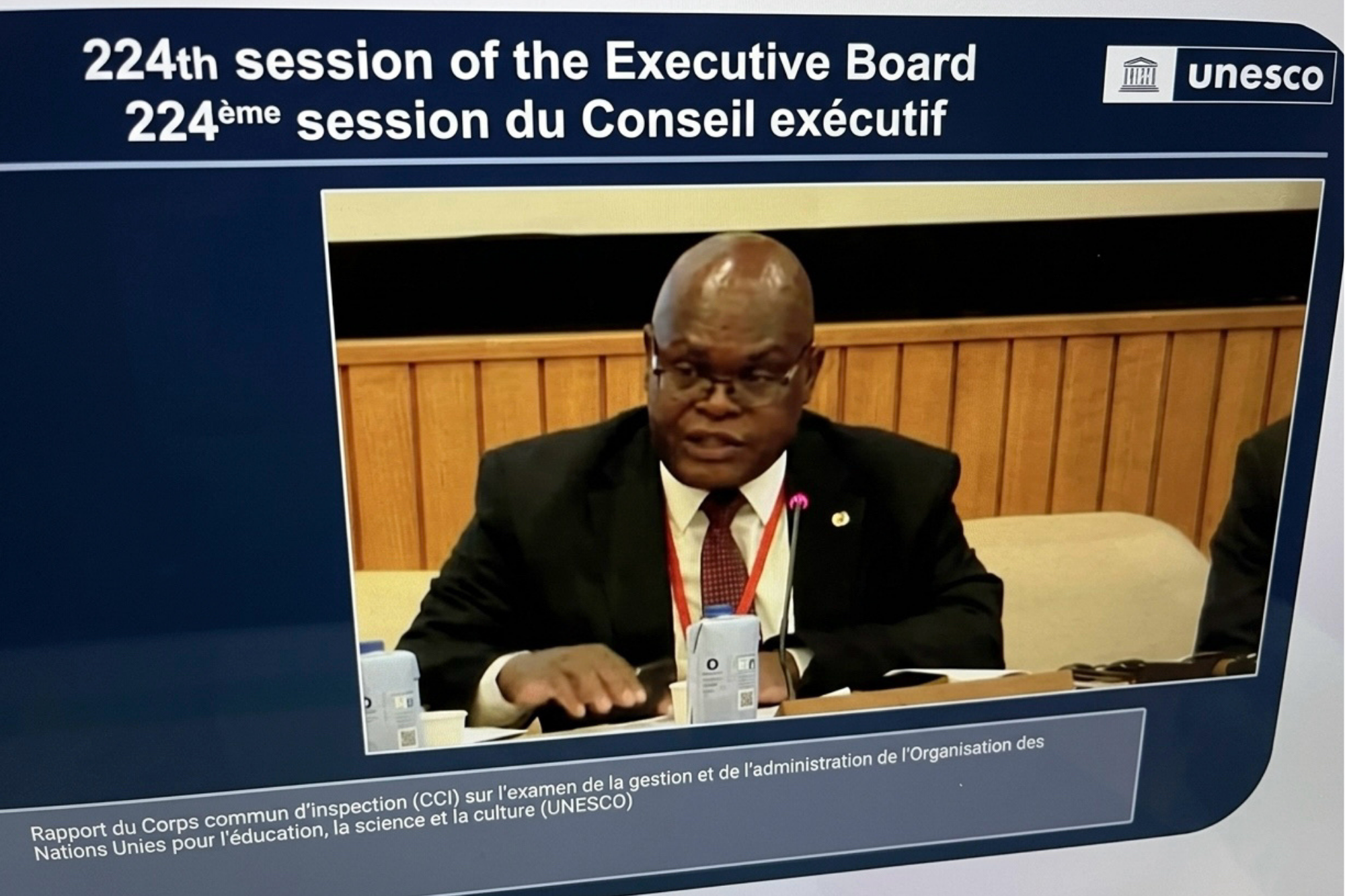
Paris, 9 April 2026: The Executive Board of the United Nations Educational, Scientific and Cultural Organization (UNESCO), meeting in Special Committee during its 224th session, considered the report of the Joint Inspection Unit (JIU) entitled Review of Management and Administration in the United Nations Educational, Scientific and Cultural Organization (JIU/REP/2026/1).
Presented by Inspector Gaeimelwe Goitsemang and supported by the JIU project team, the review provides an independent and comprehensive assessment of UNESCO’s governance, management, and administrative framework. It takes stock of reforms undertaken since 2017 and identifies structural challenges that continue to affect the Organization’s effectiveness, accountability, and institutional coherence.
Key Findings Presented by the Inspector
Inspector Goitsemang acknowledged the progress UNESCO has made in recent years, particularly in governance reform, oversight, human resources management, and digital transformation. However, he emphasized that several structural and managerial challenges continue to constrain the Organization’s performance.
Among the most significant issues identified were:
- The absence of a centralized decision‑tracking system, which weakens accountability and limits the governing bodies’ ability to monitor implementation.
- Outdated working methods of the Executive Board, reducing its strategic focus.
- Overlapping mandates and unclear divisions of responsibility among governing bodies, leading to duplication and blurred accountability.
- Strained relations between executive leadership and the Executive Board.
- Capacity and impartiality gaps within the Secretariat of the Governing Bodies.
- Lack of a formal framework governing internal candidacies for the post of Director‑General.
Beyond governance, the review highlighted persistent coordination challenges between Headquarters and field offices, weak integration of evaluation into results‑based management, and a financial and partnership model increasingly reliant on voluntary contributions without sufficient risk‑management safeguards.
The Inspector also underscored the importance of a credible and accessible internal justice system, noting that the fair and consistent application of rules and regulations is essential to maintaining staff trust, safeguarding due process, and ensuring that managerial decisions are perceived as legitimate and impartial. Weaknesses in this area, he noted, contribute to declining staff engagement and uneven application of human resources procedures.
In light of these findings, the Inspector underscored the need for stronger governance, clearer accountability, improved coordination, a robust internal justice system, and renewed trust to ensure UNESCO’s long‑term effectiveness and sustainability.
Presentation and Secretariat Response
Responding on behalf of the Director‑General, Jennifer Linkins, Assistant Director‑General for Administration and Management (ADG/ADM), welcomed the JIU review as a timely and constructive assessment. She confirmed that the Secretariat supports all 13 formal recommendations, many of which are already being implemented through the ongoing UNESCO80 reform roadmap.
The official management response to the report will be finalized and published shortly after the conclusion of the Executive Board session, in accordance with established procedures.
Member State Interventions
Member States broadly welcomed the JIU report and emphasized its relevance for UNESCO’s ongoing reform efforts. Several delegations expressed strong support for the review and its findings, noting recurring issues identified across multiple oversight exercises, including weaknesses in governance, decision‑tracking, accountability frameworks, risk management, human resources practices, evaluation use, and the functioning of the internal justice system.
Recognizing the importance of translating the JIU’s findings into concrete action, the Special Committee of the Executive Board undertook to adopt decisions that will ensure the full and timely implementation of all recommendations. Member States stressed that meaningful reform requires more than acknowledging the issues identified by the JIU; it demands a structured and sustained follow‑through process capable of driving measurable institutional change.
Moving Forward
In closing, Inspector Goitsemang thanked Member States for their constructive engagement and the Secretariat for its positive response. He reaffirmed that the JIU remains available to support UNESCO and its governing bodies as implementation progresses, and noted the relevance of upcoming JIU work, including reviews on digital transformation and staff recruitment practices.
The discussion confirmed broad recognition among Member States that the JIU review represents an important opportunity to strengthen governance, reinforce the internal justice system, restore trust, and enhance UNESCO’s effectiveness in a challenging institutional and financial environment.
Read the full report:
https://www.unjiu.org/sites/www.unjiu.org/files/jiu_rep_2026_1_0.pdf
Read the review highlights:
https://www.unjiu.org/sites/www.unjiu.org/files/jiu-rep-2026-1_review_highlights.pdf